- Apr 16, 2025
Sadhu Stories part 4: Initiation & Becoming Maya Giri
Ten days at the Kumbh Mela felt like stepping into a timeless dreamscape - dusty, chaotic, and utterly sacred.
I lived in a tent city with the Sadhus, slept on the ground, smoked endless chillums around holy fires, and drank countless cups of sugary chai. Each day bled into the next in a haze of ash and incense, blessings and banter, never-ending rounds of chillums, roaming, sometimes on my own, sometimes in the company of other Sadhus. Somewhere along the way, I stopped being a visitor. I was no longer a tourist or even a seeker, and the last day before we left, I received my initation and my new name: Giri.
With so many tents, ranging from the most basic - a solitary Sadhu sitting on his own with a small fire and a piece of plastic awning as a makeshift sun-roof over his head, to giant fancy structures, some with flashing lights and massive loudspeakers blaring the songs of Shiva, others more peaceful and private, with sprawling interiors with room for hundreds if not thousands of pilgrims to come to stay, or to sit and meditate, chant, or listen to the words of wisdom spoken from the mouth of the God-like Guru in residence.
I can’t say it was a peaceful place, but despite the chaos, noise and dirt, there was undeniably something sacred in the air. When out roaming, every moment someone was calling me; a Sadhu waving to me wanting to give me his blessings, a fellow pilgrim asking “madam, which your country?”, someone wanting to take selfies together, or selfless Seva’s trying to hand me heaping plates of food.
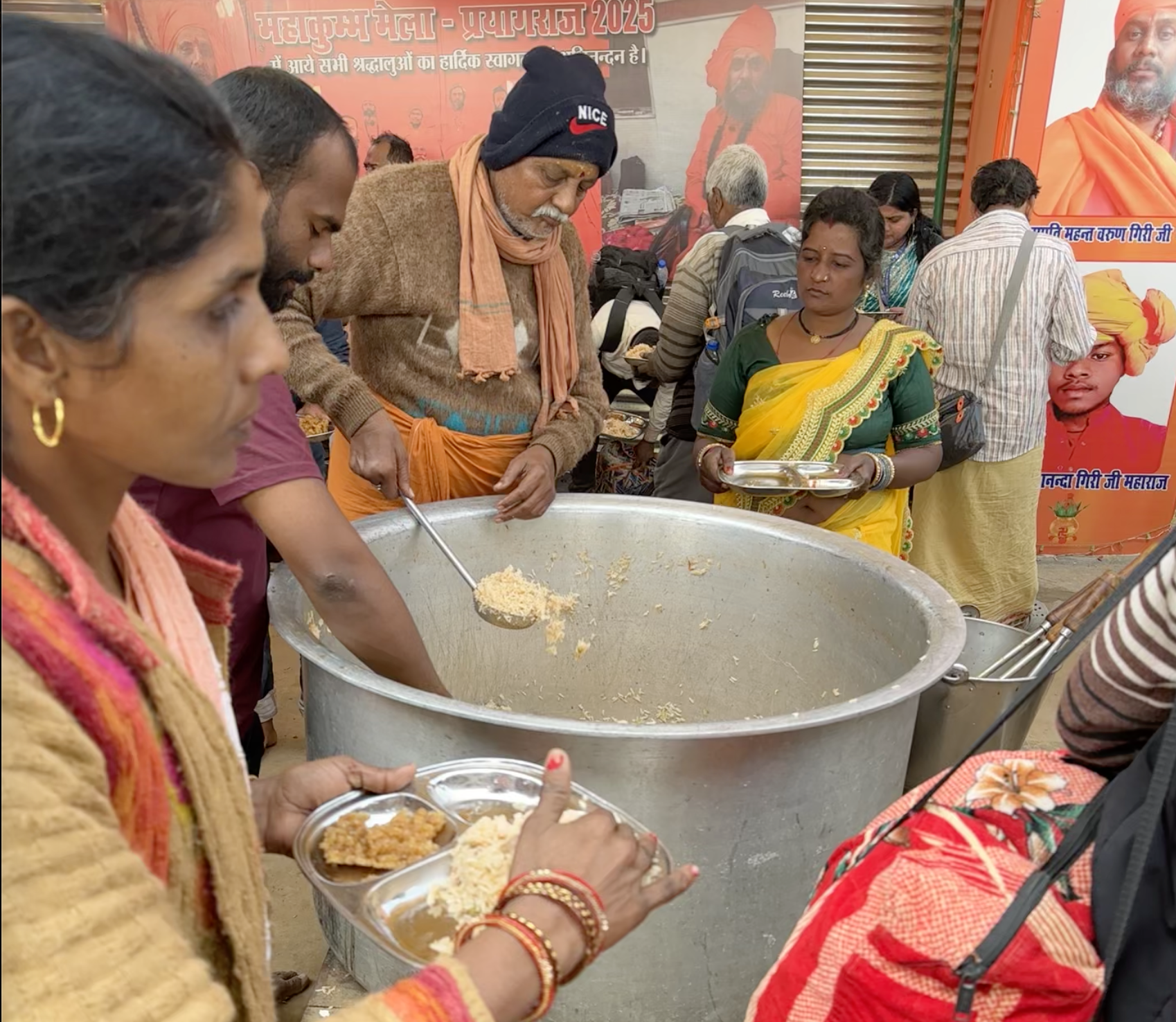
It was impossible to be alone, the only place I could find solitude was my own room in our mega-tent. It was also impossible to go hungry at the Kumba Mela.
Every time I entered a tent and sat down, countless cups of chai (and chillums) were immediately served. Many of the bigger ashrams were also offering all kinds of food, serving countless thousands of free meals each day from pots big as bathtubs to long lines of pilgrims. There were also shops selling chai, biscuits, deep fried sandwiches and samosa everywhere.
I had fucked up a little in my planning before leaving Delhi - I thought I would be able to get cash out at an ATM by the bus station. No such luck! I ran around to at least 10 banks but all the ATMs were either closed or out of order. This meant I arrived at the Kumb with less than the equivalent of twenty euro in my wallet, something that made me feel uncomfortable but in hindsight gave me a profound lesson in humility.
After the first three days, when my travel companions decided to leave, we had a long discussion in our private chambers to figure out how much we should give to Rakesh Giri for having given us a place to stay, fed us and shared his charras so generously. He was very happy with the crisp 50 euro bills they gave, and they disappeared into one of the many hidden pockets in his leopard-print waistcoat.
He and the other Sadhus were also happy (and impressed?) that I took them up on their offer and decided to stay longer. Something about a woman able to make decisions on her own.
When I spoke to Rakesh Giri and Masta Giri about not having any cash and they replied “no worries, you don’t need money here”. So I did my best to simply be, and receive, and let myself be looked after in true Sadhu style.
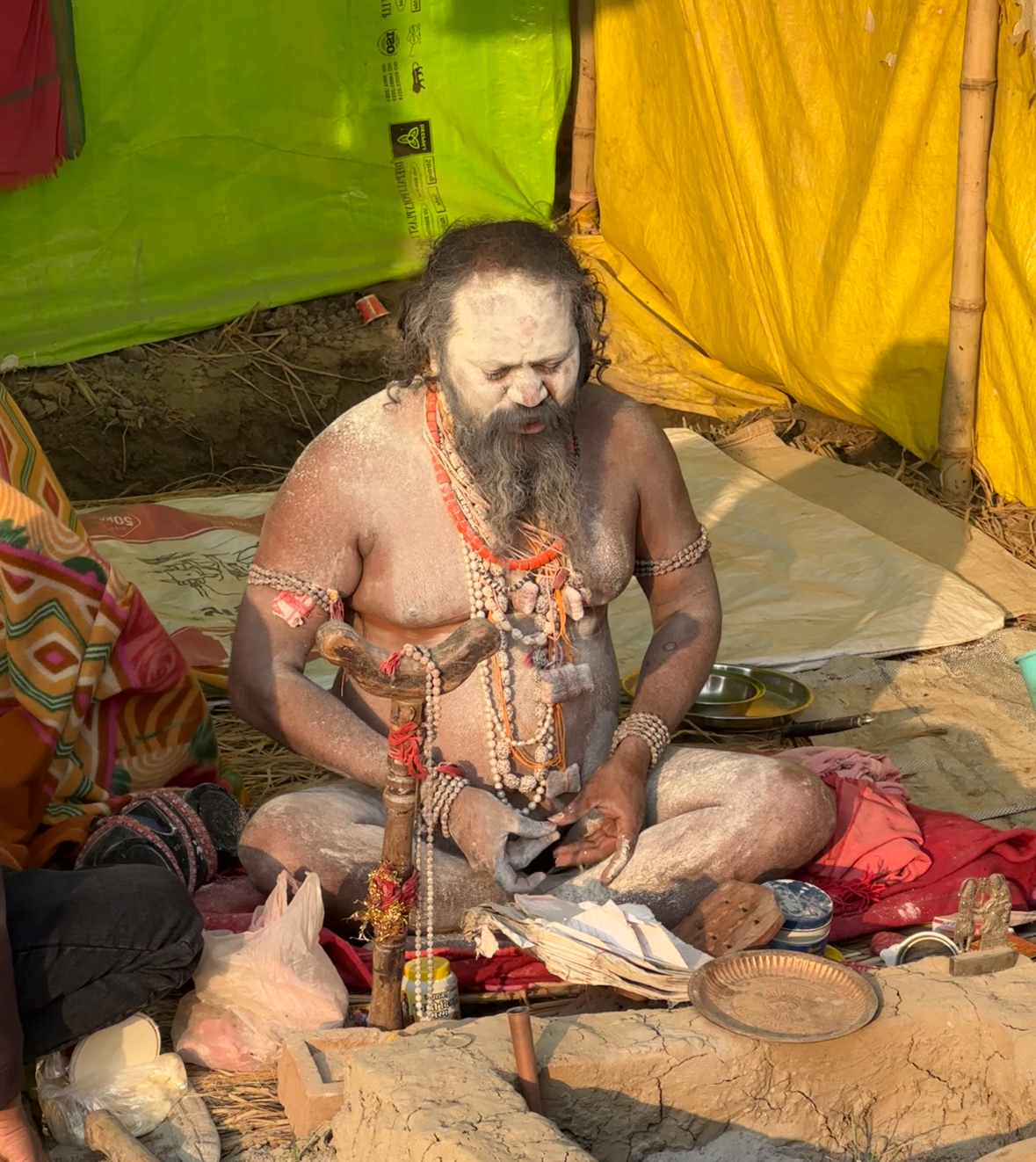
In our tent, food was only served in the late evenings, but whenever I went out roaming, someone would call me over to shove plate of free Bandhara into my hands, or offer to buy me a cup of chai in exchange for a short conversation.
I spent the little money I had buying small packets of Gold Flake cigarettes, the Sadhus favorites, that they open to mix the tobacco with their charras (hashish) and then put into their chillums.
These were always received without thanks. No please, no thank yous. If you have it, you give, if you need it, you simply ask for it. When you ask a Sadhu for something, they’ll throw it at you (except for chillums of course, which are passed only with the right hand). At first, it felt rude to have things thrown at me instead of being politely handed the item, like I’ve been trained to do. I soon got used to it, and started throwing things too.
There are a few reasons for this behavior. One is to avoid making physical contact, to keep ones own energy unpolluted, but it also serves to show ones detachment to material things.
Some devotees would try to hand their donations to the Sadhus, but they would not touch the money or items offered, instead pointing to the floor or their donation bowls. Seekers touch the feet of the Sadhu, the Sadhu touches their heads or backs, another way of keeping the hierarchy clear.
When people came to sit with us, many would give money to all the Sadhus present, often giving the largest sum to the Guru, and then smaller amounts to the lower level Sadhus.
After a few days, people started giving me money too. The first time this happened, it felt weird, I wasn’t sure what to do, and hesitantly looked over at Rakesh Giri. He just smiled, nodded approvingly and showed me that I was now to put up my right hand and bless the seeker just like he did.
As the days went on, more and more people came to ask my blessings, some very insistent, pointing at their heads and some even requesting that I tap them with the peacock feather wand. I was especially popular with village women, sometimes the tent would fill up with with women giving me curious and admiring looks, some asking me a lot of questions, and many wanting my blessings more than the Guru’s. Rakesh Giri loved it, and said “the women love you so much, they think you are very lucky”.
I played my part and after the givers left, I did like the other Sadhus and I picked up the money at my feet and put it on the Gurus ever growing pile. A few times a day, Rakesh Giri would stash the cash under the Persian rug he sat on, and we would joke and say he was building a mountain under his ass. One day in Varanasi, he pulled out all the money and wrapped it in a towel and told me to go count it.I estimate it was about five kilos of cash. He got one of his cheli (disciples), a very soft spoken Pundit (priest) who performs the fire ceremonies at the Ganges there every sunrise and sunset, to walk with me to the hotel room, a bit like a spiritual body guard, where I spent the next seven hours counting cash. The ten rupee notes especially are very dirty, my fingers were black by the time I finished.
I guessed it must have been a real honor to be trusted with all his money. He also started putting his many watches, silver and gold jewelry into my bag, which actually started to become a bit annoying as my bag became heavier and heavier by the day. He often said “anything you want, you ask me, I give you”. He also made it very clear that he didn’t want me to give money to any other Sadhu, to show my allegiance to him as my only Guru.
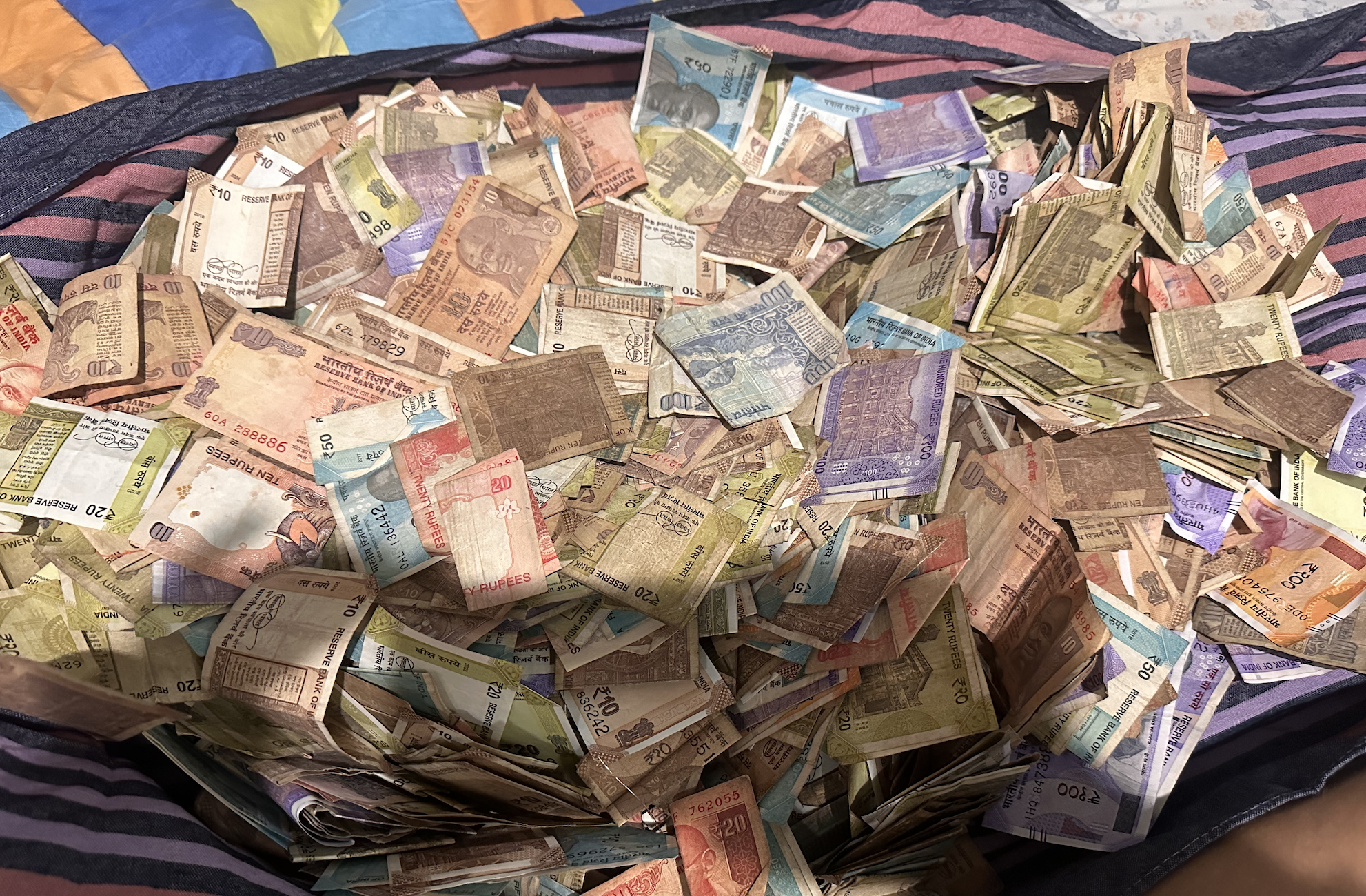
(counting cash for my Guru)
One day in Varanasi we went to visit another high level Guru, who was sitting naked on a wooden bed in his tent, massively long dreads wrapped around his head like a big brown halo, surrounded by his adoring chelis. This Sadhu has been silent for many years, but communicated with very expressive eyes, facial expressions and hand gestures. We drank countless cups of chai and smoked from very tiny chillums. He was the first I met who insisted on single use chillums. Every round, a new chillum wrapped in newspaper was pulled out of a big bag, then unceremoniously discarded in an evergrowing pile at his feet. I didn’t really vibe with this Sadhu, I’m not sure why, he just didn't inspire devotion or admiration in me.
After some time, he got out his rudraksha malas, giant ones, some double and triples, encased in silver and gold. He was clearly showing off, wanting to make his status clear. When he handed them to me, I made sure to examine them and make an exaggerated show of how impressed I was.
Then he indicated that I put them on. They were very heavy around my neck. I briefly wondered what would happen if I kept them, just stood up and walked off, and in hindsight I kind of wish I would have, just to satisfy my curiosity. Instead I gave them back and then he started pointing and raising his eyebrows, and the others translated this to mean “now you give money”.
I pulled out a 100 rupee note. The silent Sadhu was not satisfied, and in response pulled out a 6cm thick stack of 200 rupee notes to show me how much money he had, then threw my 100 rupees back at me.
I replied “You have so much money, why do you need mine too?”.
Rakesh Giri smirked at me proudly at me, and later said “Very good, your thinking was correct” and told me to keep the 100 rupee note, because it was a blessed gift from this special silent Sadhu, and I must not spend it. Another foreigner who was there with us, was treated similarly, but he ended up being coerced out of more than 100 euro.
When we left, I had the feeling that whatever this game is, I walked away more respected than if I had bowed and acquiesced to the demand to pay.
There are more male Sadhus than women, and I only met one other female foreigner Sadhu of high status. We had a long conversation over several hours, and she shared her experiences in the Juna Akhada - the oldest, most prominent, largest and richest of the 13 Akhadas (My Guru is in the Avana Akhada, which started in the 8th century and is known for being a bit more inclusive, more austere, and less militant than the Juna Ahkada).
Coincidentally (is there such a thing?) her name is also Maya, but her Guru had given her the prefix Bhakti (which means Devotion). My Guru gave me the name Giri, after his lineage, which means Mountain. So as we sat there, Maya Giri and Maya Bhakti, surrounded by other Sadhus, I hungrily observed her behaviors and mannerisms, wanting to learn from someone much more experienced than me.
She came with a Guru from her Akhada but sharply insisted when asked that he was her “Guru-bhai, not Guruji”. The prefix -Ji is an honorific, Bhai means brother, and in this small distinction she was making it clear that she was on his level, not beneath him.
She told me that this year her Guruji (not the Guru-bhai she was roaming with that day) had finally given her the right to set up her own ashram, and that it was now under construction and she was very excited after so many years of service to finally have her own place. To be honest, I found her quite difficult to understand, which had nothing to do with language differences, but more that things that were so obvious to her, that they didn’t need to be explained were so far from my world that I even though I asked a lot of follow up questions, I almost felt more confused after hearing her answers.
Similar to the red woman Aghori I met earlier, she was holding herself tall and proud, and fiercely demanded to be respected. She had brought her own leopard print blanket that she sat on, and when a man came and tried to sit next to her, she smacked him with her iron poker and the other Sadhus shouted at the man to not get too close to her, so he moved to the other side.
Many times, I just sat observing, feeling the energies and figuring out how to maintain my composure and peace within the crowded chaos and noise. Over the countless days sitting watching the throngs of people passing by, I started seeing things that are difficult to express, but I am doing my best here.
This is what I saw: Most ‘normal’ (whatever that means) people walk like they are carrying something heavy, burdened by the sufferings of life perhaps. Many have a hunger in their eyes, when they looked at me it often felt like they wanted something from me.
I started seeing the difference between them and the (real) Sadhus, who walk tall, straight backed and carry themselves lightly, almost gliding over the ground, embodying that state of pure presence where there is no fear, worry or hurry, just ease, trust and power. If we locked eyes, which happened often, their gaze felt different, a sort of friendly curiosity, a simple acknowledgement, making me feel seen, not just looked at.
Small things matter. When you bow and touch feet, you are showing respect, but small details in how you do it shows where you put yourself lower in the rankings, and how much you are seeking validation and approval. I learned watching other female Sadhus, some who embodied that strength and power, and started to learn to trust my intuition on how to engage with those I met. I mimicked Maya Bhakti, making small nods of respect to the higher status Sadhus, and with others, instead of nodding and lowering my head, I would nod upwards, lifting my chin, confirming my place in the hierarchy.
These things are so subtle, and are hard to explain, I don't think its something you can be taught, but rather can only be learned through careful observation and personal discernment.
When the Guru is not in the tent, the ‘second’ would immediately move to sit in his place, and when he leaves, the next in the rankings would rush to take the coveted spot. A few times, I witnessed the second coming back shouting at and hit the third to reclaim the coveted spot for himself.
I also saw Gurus shouting at their disciples, over all kinds of things, like the water buckets for their showers not being the perfect temperature, for putting too much salt in the food, or not making chai fast enough. Words like “madachut” (motherfucker) and “gunda” (‘homo’) were often thrown around abundantly.
This is the land of contrasts, and while sometimes behaving like what I can only describe as wild animals, the Sadhus were also incredibly welcoming, accepting, loving, respectful and nurturing.
As I had decided to extend my stay, it so happened that I got my period while I was there. Having to explain that to the Sadhus, and ask their help in getting pads was another one of these experiences that were both uncomfortable and hilarious, but when Calcutta Baba was sent to the pharmacy to get me what I needed, and came back with the things in a discreet brown paper bag, I was immensely grateful. They told me to “take rest” and for the two days when I felt weak, my food was served in my room and they checked in on me often to make sure I had everything I needed and that I was ok.
When the time came to move on, Calcutta Baba, who speaks no English and had often shouted at me, came and squatted down in front of me, his shiny brown eyes filled with so much love, my heart ached in response to pureness and power of pure emotions silently shared. He asked me to write my name and phone number in his little notebook (I don’t expect him to ever call me, I think it was more his way of keeping a memory). Many other Sadhus also asked for my number, it felt more like an energetic exchange, their version of being Facebook friends.
Me, Rakesh Giri and Masta Giri set off around 11 at night. The two Sadhus took nothing more than their Sadhu bags and small backpacks, leaving the tent, and all the things that had accumulated there without a backwards glance. Our travel to Varanasi was incredibly smooth. I had stayed at the Kumb for so long Iwas grateful to leave the smog, the dirty toilets and the crowds behind. It also felt quite cool to be traveling in the company of two Sadhus.
I ended up staying with my Guru in Varanasi for another month, and I more to share from my time in the holy city where people come to die, where bodies are burning all along the ghats next to the Ganges.
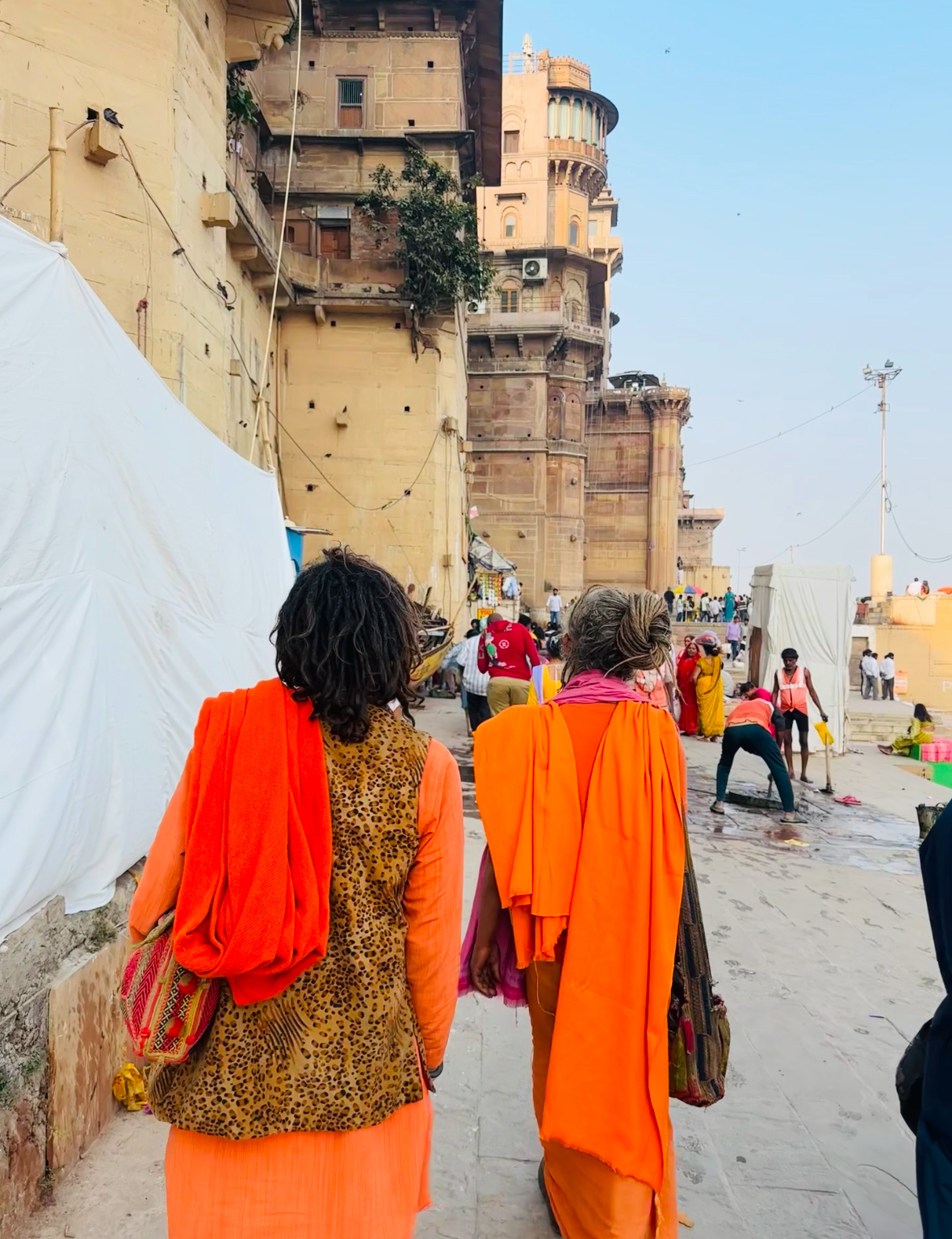
(roaming with Rakesh Giri Baba and Masta Giri Baba in Varanasi)
Even though I’ve already written so much, it feels like I am still just scratching the surface of my experiences.
Thank you so much for reading, and for all your beautiful comments and responses so far. It means the world to me, and I am glad that I am able to share these stories that hopefully inspire you to deepen your own practice of all the gifts the Sadhus have shared with the world, after all they are the inventors of all things Yoga, Breathwork, and so much more.
Sadhu Stories part 5: My Guru